

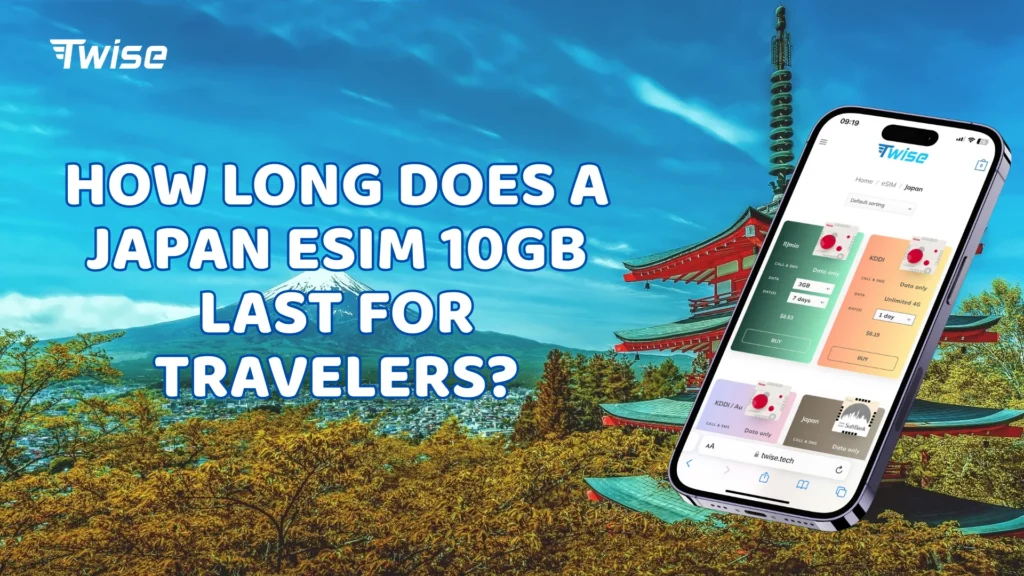
How Long Does a Japan eSIM 10GB Last for Travelers?
Jan
A Japan eSIM 10GB is one of the most popular choices among international travelers. It’s affordable, easy to install, and seems like a reasonable amount of data for a short or medium-length trip. Many travelers assume that 10GB will comfortably last their entire journey.
However, the reality is more complex.
Actual data consumption in Japan can vary dramatically depending on:
- Your travel style
- Which apps you use
- How often you navigate
- Daily habits like social media, video streaming, and cloud backups
Two travelers on the same itinerary can burn through data at completely different speeds.
The goal of this guide is simple: help you understand how long a Japan eSIM 10GB really lasts—and whether it’s enough for your travel needs, or if upgrading to a higher data plan makes more sense.
By the end of this article, you’ll know:
- How data is consumed day by day in Japan
- Which habits drain 10GB the fastest
- Which traveler types can safely choose 10GB
- When a 20GB, 30GB, or unlimited plan is the smarter option
1. What Is a Japan eSIM 10GB and How Does It Work?
A Japan eSIM 10GB is a prepaid digital SIM that provides 10 gigabytes of high-speed mobile data during a fixed validity period (usually 7–30 days).
How it works:
- Delivered digitally via QR code
- Installed directly on your phone (no physical SIM)
- Connects to major Japanese networks such as:
- Docomo
- KDDI (AU)
- SoftBank
One of the biggest advantages of a Japan travel eSIM is that it can be installed before arrival, allowing you to land in Japan with internet access immediately at the airport.
What happens after 10GB is used?
A domestic Japan eSIM connects directly to local carrier infrastructure instead of routing through international roaming networks. This results in several clear advantages:
- Higher network priority, especially during peak hours
- More stable and consistent speeds for navigation, streaming, and work
- Stronger coverage beyond major cities, including rural and remote areas
These benefits become especially noticeable when traveling to destinations such as Hakone, Mount Fuji, Nikko, Hokkaido, or Okinawa, where roaming-based eSIMs often experience weaker signals or slower performance.
2. Typical Data Usage for Tourists in Japan
Understanding how data is consumed daily is key to estimating how long 10GB will last.
a. Navigation (Google Maps, Apple Maps)
Navigation is one of the most frequently used apps in Japan.
- Subway routes, walking directions, transfers
- Constant GPS usage
Estimated usage:
- 50–100MB per day
- ~1–2GB per week
If you navigate all day in cities like Tokyo or Osaka, usage may be higher.
b. Translation Apps (Google Translate, ChatGPT, Camera Scan)
Japan is not always English-friendly, making translation apps essential.
- Text translation
- Voice translation
- Camera-based translation
Estimated usage:
- 150–300MB per day for active users
- ~3–6GB over 2 weeks
Live camera translation consumes data faster than text-based translation.
c. Social Media (Instagram, TikTok, Facebook, LINE)
Social media is the biggest variable in data consumption.
Light usage (scrolling + messaging):
- 300–500MB per day
Moderate usage (scrolling + stories):
- 0.5–2GB per day
Heavy usage (Reels, TikTok, uploads):
- 3–5GB per day
Auto-playing videos dramatically increase data usage.
d. Video Streaming (YouTube, Netflix)
Streaming consumes data quickly—even at lower resolutions.
- 480p: 250–500MB per hour
- 720p: 700MB–1GB per hour
Just one evening of streaming can wipe out a large portion of a Japan data eSIM 10GB.
e. Messaging Apps (WhatsApp, Messenger, iMessage, LINE)
Messaging is relatively data-efficient.
- Text + stickers: minimal
- Voice messages and calls: moderate
Estimated usage:
- 10–30MB per day
This is not a major concern unless combined with video calls.
f. Cloud Backup (Google Photos, iCloud)
This is the most dangerous hidden data drain.
- Automatic photo and video backups
- High-resolution uploads
If left enabled, cloud backup can consume several GB in minutes, especially after a day of sightseeing.
Read more: Docomo eSIM Japan: Is It the Best Network Option for Travelers?
3. How Long Does Japan eSIM 10GB Last for Different Traveler Types?
a. Light User (3–5 Days to 2 Weeks)
Usage pattern:
- Maps
- Messaging
- Basic browsing
- Instagram 10–20 minutes/day
Estimated consumption:
- 0.5–1GB per day
10GB lasts 14–20 days
b. Normal Tourist
Usage pattern:
- Google Maps daily
- Translation apps
- 1 hour/day on social media
- Occasional YouTube
Estimated consumption:
- 1–1.5GB per day
10GB lasts 7–12 days
c. Heavy User
Usage pattern:
- Daily videos
- Photo uploads
- Reels/TikTok
- Cloud backup not disabled
Estimated consumption:
- 2–3GB per day
10GB lasts 3–5 days
d. Digital Nomad
Usage pattern:
- Video calls
- Cloud sync
- Hotspot usage
Estimated consumption:
- 3–5GB per day
10GB lasts 2–4 days
4. Key Factors That Drain Your 10GB Faster Than Expected
Your 10GB data plan can run out much faster than you think – often because of everyday app behavior rather than heavy use. Common data drains include:
- Autoplay videos on TikTok, Instagram Reels, and YouTube Shorts
- Uploading 4K or high-resolution videos to social media or cloud storage
- Automatic backups from Google Photos or iCloud running in the background
- Tethering or hotspot sharing with a laptop or other devices
- Navigation apps running all day, especially with live traffic updates
- 5G networks loading higher-quality content by default, which increases data consumption
Ironically, faster networks don’t reduce data usage – they often make apps consume more data automatically, unless settings are adjusted.
5. How to Track and Control Your Data Usage in Japan
Managing your data usage helps you avoid running out of data mid-trip, especially when using a fixed or limited eSIM plan. Here are the most effective ways to stay in control.
a. Built-In Data Usage Tools
Both iPhone and Android devices have built-in tools that let you track mobile data consumption in real time.
- iPhone:
Go to Settings → Cellular → Cellular Data Usage - Android:
Go to Settings → Network → Data Usage
To stay safe, set usage alerts or reminders when you reach 70–80% of your data limit, giving yourself time to adjust or top up.
b. eSIM Provider Dashboard or App
Most eSIM providers offer a web dashboard or mobile app where you can:
- Check your remaining data balance
- Track daily or real-time usage
- Top up or extend your plan instantly if needed
This is often the fastest way to manage your plan while traveling.
c. Set Data Saver Mode
A few simple settings can significantly reduce data consumption:
- Download Google Maps for offline navigation
- Enable Low Data Mode in apps like LINE or WhatsApp
- Turn off video autoplay on social media apps
- Disable automatic cloud backups (iCloud, Google Photos)
- Save travel guides, tickets, and confirmations for offline access
With these steps, you can stretch your data further and enjoy a worry-free trip across Japan.
6. Is 10GB Enough for Japan? When to Choose More
a. Choose 10GB if:
- Trip is 3–7 days
- Light social media usage
- Heavy reliance on hotel Wi-Fi
b. Choose 20–30GB if:
- Trip is 10–20 days
- Frequent navigation and translation
- Regular Instagram uploads
c. Choose Unlimited (FUP) if:
- Staying close to 1 month
- Content creator
- Remote worker
- Daily video streaming
Comparison Table
| Data Plan | Best For | Estimated Duration |
| 10GB | Light users | 7–15 days |
| 20GB | Normal tourists | 10–20 days |
| 30GB | Heavy tourists | 15–30 days |
| Unlimited | Power users | Stress-free |
7. Best Japan eSIM Providers Offering 10GB Plans
a. Twise Japan eSIM (SoftBank / KDDI / Docomo)
Twise is one of the most reliable options for travelers looking for a 10GB Japan eSIM with stable performance across the country.
- True domestic Japan eSIM
Twise works directly with Japanese carriers, especially KDDI (AU) — not via international roaming aggregators. This ensures:
- Lower latency
- Higher network priority
- More stable speeds during peak hours
- KDDI (AU) as the core network partner
KDDI is Twise’s flagship Japan product, offering:- Fast and stable 4G/5G speeds
- Excellent performance in subways, indoor areas, and transport routes
- Strong coverage beyond major cities, unlike many roaming eSIMs
- Fast technical handling & instant QR delivery
Thanks to direct carrier integration, Twise delivers:- QR code within 1–2 minutes after payment
- Faster technical troubleshooting compared to reseller platforms
- Reliability comparable to US domestic SIMs like T-Mobile
- Flexible 10GB plans with real-world usability
- Uses SoftBank, KDDI (AU), or Docomo depending on the plan
- Strong nationwide coverage across:
- Tokyo, Osaka, Kyoto
- Regional areas and transport corridors
- Ideal for tourists using:
- Google Maps & Apple Maps
- Messaging apps (LINE, WhatsApp)
- Browsing, email, and daily travel needs
- Better value than most international travel eSIMs
Twise positions KDDI plans at a sweet spot — offering better speed and stability than cheap roaming eSIMs, without the inflated pricing of premium international brands.
With transparent pricing, domestic carrier access, and excellent technical reliability, Twise’s 10GB Japan eSIM is a safe, high-performance choice for travelers who want their internet to work the moment they land.
b. Airalo (Sakura eSIM)
- Easy installation
- Popular global brand
- Good for short stays
c. Ubigi (Docomo Network)
- Excellent rural coverage
- Stable nationwide signal
d. Nomad Japan
- User-friendly app
- Strong Android support
e. Klook / JTB Partner eSIM
- Convenient for Southeast Asian travelers
- Depends on partner network
8. Real Usage Examples
Family of four:
Parents rely on maps, kids on social media → 10GB gone in 5–6 days.
Solo traveler:
Maps + light Instagram → 10GB lasts 10–12 days.
Business traveler:
Emails + video calls → 10GB gone in 3–4 days.
Content creator:
Daily uploads → 10GB gone in 2–3 days.
Conclusion — Is 10GB Enough for Your Japan Trip?
For most light to moderate travelers, a Japan eSIM 10GB can last anywhere from 5 to 12 days.
However:
- Heavy social media users
- Video streamers
- Remote workers
…will almost certainly need 20GB, 30GB, or unlimited data to avoid running out.
Choosing the right Japan travel eSIM ensures a smooth, stress-free experience—no slow speeds, no panic top-ups, and no surprises.
Final advice:
If you’re unsure, it’s safer to slightly overestimate your data needs than to run out halfway through your trip.

Twise’s customer support is available 24/7 to assist you. You can contact them through the official channels below for immediate help:
- Facebook Fanpage: Twise
- Email: support@twise.tech
- WhatsApp: (+1) 818-915-0777
